ART vs. EMDR: Which Trauma Therapy Is Right for You?
Published: August 20, 2026 | Updated: August 20, 2026
By BrainBody Wellness Counseling
Clinically reviewed by Ali Schilling-Iverson, Psy.D.

You understand what happened. You have talked about it, tried coping skills, and reminded yourself that you are safe—yet your body still reacts as if the past is happening now.
A memory suddenly takes over. Your heart races. You freeze, shut down, or avoid situations that remind you of what happened. It can be frustrating when insight alone does not bring relief.
That does not mean you have failed at healing. It may mean your brain needs a different way to process the experience.
Accelerated Resolution Therapy (ART) and Eye Movement Desensitization and Reprocessing (EMDR) are two trauma-focused therapies that use bilateral eye movements. Although they may look similar, they follow different paths toward healing.
Both Use Eye Movements—But Not the Same Process

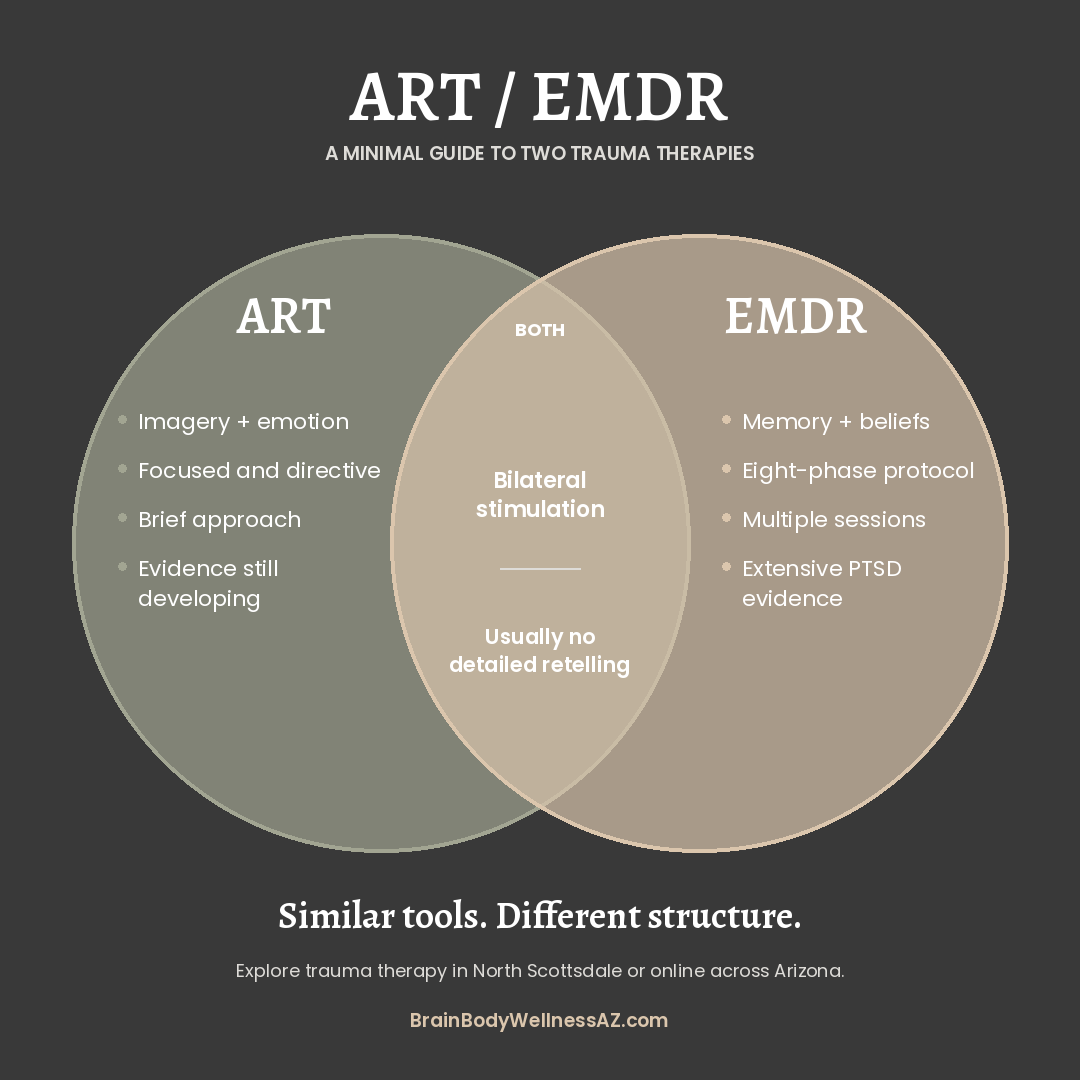
ART and EMDR may help reduce the emotional intensity connected to distressing memories. During both therapies, a trained clinician guides you through eye movements while you focus on parts of an upsetting experience.
You remain awake, aware, and in control. Neither approach erases the memory. The goal is to help the memory feel less immediate and emotionally overwhelming.
You also may not need to describe every detail aloud. However, you will still think about parts of the experience during treatment.
EMDR Builds Healing in Eight Phases
EMDR is a structured, eight-phase psychotherapy that includes history-taking, preparation, identifying target memories, bilateral stimulation, strengthening more adaptive beliefs, and reassessing progress.
Before memory processing begins, your therapist helps you build grounding and coping skills. During processing, you briefly focus on the memory, related beliefs, emotions, and body sensations while following eye movements, taps, or alternating sounds.
EMDR may be a good fit if:
You want a gradual, structured treatment process.
Several memories or long-standing patterns need attention.
You experience trauma symptoms, PTSD, anxiety, or negative self-beliefs.
You value an approach with an extensive research base.
The U.S. Department of Veterans Affairs identifies EMDR as one of the most effective treatments for PTSD. Treatment length varies according to your symptoms, history, readiness, and goals. Learn more about EMDR research from the National Center for PTSD.
ART Uses Imagery to Change the Emotional Response
Accelerated Resolution Therapy is also structured and uses eye movements, but it places greater emphasis on visualization and imagery rescripting.
With your therapist’s guidance, you recall the distressing experience and notice the emotions or physical sensations connected to it. You then use imagery to change how the memory is experienced internally. The facts remain the same, but the painful images and emotional response may become less intense.
ART may appeal to you if:
One or more specific memories feel emotionally “stuck.”
You prefer a focused, brief approach.
You do not want to describe the trauma in detail.
Visual exercises feel comfortable and natural to you.
Early studies suggest that ART may be a promising, time-efficient treatment for trauma-related symptoms. However, its research base is smaller than EMDR’s, and researchers note that more high-quality studies are needed. Review the current ART research summary.
ART vs. EMDR at a Glance
The Better Therapy Is the One That Fits You
There is no universal winner in the ART vs. EMDR comparison. The right choice depends on your symptoms, treatment history, comfort with visualization, emotional stability, and goals.
Some people prefer ART’s focused structure. Others benefit from EMDR’s phased preparation and broader protocol. If you are experiencing severe dissociation, active substance dependence, significant instability, or a current crisis, your therapist may recommend stabilization or another level of care before beginning trauma processing.
A consultation with a trained trauma therapist can help you make an informed decision without pressuring you into a particular treatment.
Trauma Therapy in Scottsdale and Across Arizona

BrainBody Wellness Counseling offers compassionate, individualized trauma therapy that looks beyond symptoms and considers the connection between thoughts, emotions, memories, and the nervous system.
We provide:
Accelerated Resolution Therapy in Scottsdale and online across Arizona
EMDR therapy in Scottsdale and throughout Arizona by telehealth
Traditional weekly EMDR sessions and EMDR intensives
In-person counseling in North Scottsdale
Secure online trauma therapy across Arizona
Jenna Ciancanelli, LPC, provides ART for teens ages 13+ and adults. Our EMDR-trained therapists serve children, teens, and adults, depending on the clinician.
You do not need to know which therapy you want before reaching out. Contact BrainBody Wellness Counseling or complete our therapist match form to begin with a free 10-minute phone consultation.
Frequently Asked Questions
Is ART the same as EMDR?
No. Both use bilateral eye movements, but ART emphasizes imagery rescripting, while EMDR follows an eight-phase memory-processing protocol.
Is ART faster than EMDR?
ART is designed as a brief therapy, but no specific number of sessions can be guaranteed. Treatment length depends on the person, symptoms, and goals.
Can EMDR or ART help with anxiety?
Both may be used when anxiety is connected to distressing experiences or memories. A clinician can determine whether trauma processing or another anxiety treatment is more appropriate.
Can I receive ART or EMDR therapy online in Arizona?
Yes. BrainBody Wellness Counseling offers in-person trauma therapy in North Scottsdale and secure telehealth options across Arizona. Availability varies by clinician.
This article is for educational purposes and does not replace individualized mental health assessment or treatment.